
Many reagents possess high reactivity, and it can be said that this reactivity is the very life of a reagent. However, because of this high reactivity, reagents are susceptible to change and deterioration, and many also exhibit toxicity or hazardous properties.
To use such reagents properly, it is essential to fully understand their properties, handle them with the utmost care, and make the most of their unique characteristics.
-
Purchasing Reagents
-
Choosing Reagents Suitable for the Intended Use
-
(1) Choosing Reagents of Appropriate Quality
-
Many of the tens of thousands of types of reagents are marketed with the manufacturers taking responsibility for maintaining their quality.
Furthermore, there are cases where reagents are manufactured under more advanced quality control, such as JIS-marked reagents based on the Industrial Standardization Act, standard solutions with JCSS calibration certificates based on the Measurement Act, and reference materials for volumetric analysis certified under JIS Q 17034. Since these can be described as reagents with guaranteed appropriate quality, it is desirable to purchase those with clearly defined quality.
Reagents specified in JIS are labeled as ""Reagent Special Grade,"" ""Reagent First Grade,"" etc. Naturally, their quality conforms to Special Grade or First Grade, and these labels serve as a good guide for judging quality levels. When purchasing reagents, it is necessary to choose those with clear quality labeling, quality assurance, and clearly defined responsibility for quality. As necessary, have the manufacturer's certificate of analysis attached. Alternatively, methods such as purchasing items that have passed receiving inspections are also considered good ways to purchase reagents.
The required grade varies depending on the intended use. For example, when used for simple qualitative analysis, it is not necessary to use a reference material with 99.99% purity; Special Grade or, in some cases, First Grade items are sufficient. Conversely, for the standardization of titrimetric solutions, even Special Grade items are unsuitable, and reference materials for volumetric analysis specified in JIS K 8005 must be used.
JIS, the Japanese Pharmacopoeia, Japan's Specifications and Standards for Food Additives, and various laws and regulations often specify the standards or quality of reagents to be used, and reagents must be selected accordingly.
On the other hand, if reagent standards or grades are not specified, it is necessary to clarify the purpose of use when purchasing and select a reagent of a quality suitable for that purpose. Quality content may differ between manufacturers even for the same grade labeling. Particularly for items not specified in official standards such as JIS, they are subject to the manufacturer's own standards; therefore, simply specifying Special Grade or GR may result in quality content different from what is required.
To select the required reagent, it is helpful to utilize JIS standard documents, overseas reagent standard documents, and catalogs issued by various suppliers. Catalogs are available in CD-ROM versions, and recently, many suppliers post their catalogs on their websites, allowing information to be obtained via the internet.
Catalogs issued by various suppliers generally list the product name, net content, price, grade/type, and application category, and in many cases, also include quality specifications and labeling for applicable legal regulations.
Currently, many catalogs issued by suppliers list reagents in alphabetical order, followed by those in Japanese syllabary order or those listed according to compound classification. Listing in alphabetical order is common not only because it is easy to use as an index, but also because it has the advantage of effectively combining a classification-based format—for example, when researching copper salts, most of those compounds can be found by opening the ""Copper"" section.
Additionally, an increasing number of recent catalogs list application-based categories redundantly at the end of the volume. This is convenient for purchasing because when planning an experiment (such as liquid chromatography), almost all reagents used for that experiment are listed together.
Note that reagents for such special applications may be available as separate printed materials or booklets in addition to the catalog, so it is convenient to request and use them as needed.
-
Many of the tens of thousands of types of reagents are marketed with the manufacturers taking responsibility for maintaining their quality.
-
(2) Purchasing Only the Required Quantity
-
If unused reagents are stored for a long time, they may eventually have to be discarded because they become unusable due to changes over time. Furthermore, using old reagents may lead to unreliable test results.
Reagents should be purchased in the required quantities whenever possible, and it is desirable to open and use new reagents as fresh as possible.
-
If unused reagents are stored for a long time, they may eventually have to be discarded because they become unusable due to changes over time. Furthermore, using old reagents may lead to unreliable test results.
-
-
When Receiving Ordered Reagents
- There are several points to confirm when accepting ordered reagents.
-
(1) Inspecting the Label Contents
-
Compare the name, grade, lot number, manufacturer name, etc., written on the label of the received reagent with the order form, and confirm that they are correct.
It is necessary to be careful, as reagent names may differ from common names and may follow IUPAC nomenclature or other names, so ordered reagents may arrive under a different name.
Lot numbers are linked to the manufacturer's production lot or production date, but some simply display the year and month of manufacture.
-
Compare the name, grade, lot number, manufacturer name, etc., written on the label of the received reagent with the order form, and confirm that they are correct.
-
(2) Inspecting the Condition of the Container
- It is also important to confirm the condition of the container. Not only must you check for cracks in the bottle and ensure the stopper is intact, but you must also verify the light-shielding condition. Failure to do so may lead to deterioration of the reagent or cause an accident.
-
(3) Checking the Handling Conditions During Distribution
- For reagents that require cold storage, it is desirable to confirm whether this has been observed even during distribution. In the summer, the temperature inside a vehicle can sometimes be higher than expected, which may accelerate deterioration.
-
(4) Inspecting the Appearance of the Reagent
- It is advisable to inspect the appearance of a reagent immediately upon receipt. For solid reagents, check for deliquescence, efflorescence, discoloration, crystal form, etc. For liquid reagents, check for discoloration, precipitation, turbidity, etc. Furthermore, although not a change in appearance, it is also good to check for the presence of foreign matter.
-
-
Storage and Management of Reagents
- If reagents are not used immediately after purchase, or if there are remaining reagents, careful consideration must be given to their storage conditions to ensure they can be used in the best possible condition the next time they are needed.
-
(1) Checking Precautions
-
It is important to determine the storage location by checking whether the reagent falls under the Poisonous and Deleterious Substances Control Act, the Fire Service Act, or the Industrial Safety and Health Act, etc., based on the label or the Safety Data Sheet (SDS).
Due to issues such as ignition upon contact, it is important to establish storage locations and classify reagents by acid/alkali, liquid/solid, etc., to ensure they are stored without cross-contamination. Furthermore, it is necessary to take measures to prevent overturning or falling due to earthquakes or other causes. If ""Keep in a cool place"" is indicated, the reagent must be stored in a suitable location (for example, a refrigerator). Note that in JIS K 0050 (General Rules for Chemical Analysis), similar to WHO standards, a ""cool place"" is defined as a location between 2°C and 15°C. Care should be taken, as temperatures in an empty laboratory on a midsummer holiday afternoon can become unexpectedly high when the air conditioning is turned off.
-
It is important to determine the storage location by checking whether the reagent falls under the Poisonous and Deleterious Substances Control Act, the Fire Service Act, or the Industrial Safety and Health Act, etc., based on the label or the Safety Data Sheet (SDS).
-
(2) Recording the Date of Purchase
- Recording the date a reagent was received is effective for storage management. Simply stamping with a rubber stamp or handwriting the date on the label is often helpful in various ways. In recent years, management using reagent management software has been increasing, and the number of cases where reagents are registered immediately after purchase is also growing. Generally, except in cases where an expiration date is already written on the reagent, it is common to determine the use-by date based on the date of purchase or the date of opening.
-
(3) Recording the Amount Used
- If required by regulations, it is necessary to keep a record of the amount used each time it is utilized. Recently, it has become possible to manage this easily using reagent management software.
-
(4) Use-by Date After Opening
-
Reagents often have different rates of change before and after opening. Furthermore, these changes can vary significantly depending on storage conditions.
Recently, there is an increasing demand for use-by dates after opening; however, as mentioned above, fixed data cannot be provided due to differences in how each user handles them. General usable periods are described below.
Solvents: Most solvents are stable and can often be used for 3 to 12 months after opening.
Acids: Most acids are very stable and can often be used for at least 6 months after opening.
Salts: Many inorganic salts are stable and can often be used for at least 6 months after opening.
pH Buffer Solutions: Buffers with a pH of less than 7 can often be used for 2 to 3 months after opening. If the pH exceeds 7, the limit is often 1 month after opening due to the absorption of carbon dioxide.
Titrimetric Solutions: Usually, titrimetric solutions are stable, but alkaline solutions face issues with carbon dioxide absorption. Except for special cases, they can often be used for about 3 months after opening.
Standard Solutions: Although it depends on their properties and concentration, most 100–1,000 ppm standard solutions are stable for several months to about a year. However, if the concentration is 1 ppm or less, they become susceptible to change, and the limit for reliable use is approximately one day.
-
Reagents often have different rates of change before and after opening. Furthermore, these changes can vary significantly depending on storage conditions.
Recently, there is an increasing demand for use-by dates after opening; however, as mentioned above, fixed data cannot be provided due to differences in how each user handles them. General usable periods are described below.
-
When Using Reagents
-
When using reagents, it is important to be aware of the precautions in advance.
1) It is important to strictly follow the precautions displayed on the label. Reagents classified as hazardous, poisonous, or deleterious substances must be handled in compliance with relevant laws and regulations, even in small quantities. When harmful gases are generated, local exhaust ventilation must be used. If substances are highly corrosive, the use of protective gloves is essential. Furthermore, flammable reagents such as organic solvents must never be handled near open flames or heat sources.
2) Preventing reagents from deteriorating during use is also critical. Depending on the properties of the reagent, measures such as avoiding direct sunlight or handling them within a cleanroom or dry room are necessary.
3) For liquid reagents, confirmation before use is important. In summer, droplets may adhere to the mouth or neck of the bottle; this is a result of condensation from volatilized vapor, which can change the concentration of a standard solution. In such cases, gently swirl the reagent bottle to ensure uniformity before opening the cap. Conversely, vigorous shaking should be avoided, as it can cause issues such as increased internal pressure in volatile reagents or easier absorption of carbon dioxide in alkaline reagents.
4) Precautions when opening reagent caps are also vital. In cases where gas is generated inside the bottle and it is pressurized, such as with ammonia water, the contents may spray out. For such reagents, it is best to slowly loosen the cap to reduce internal pressure before opening, or to cover the cap with a laboratory wiper towel and open it while wearing protective gloves.
5) When taking reagents out of a bottle, it is desirable to remove the required amount quickly and recap immediately to avoid accelerating deterioration. For liquids, it is also important not to let the liquid adhere to the threads of the cap. If liquid adheres to the threads, such as with aqueous salt solutions, crystals may precipitate there, which can lead to leaks or the ingress of carbon dioxide into the bottle. Furthermore, in the case of solvents, the resin of the cap may dissolve, potentially causing the cap to become stuck.
6) Reagents should be used up as soon as possible and should not be stored for long periods. This is especially true for those prone to rapid deterioration. Since changes often accelerate after opening, it is also important to record and manage the date of opening.
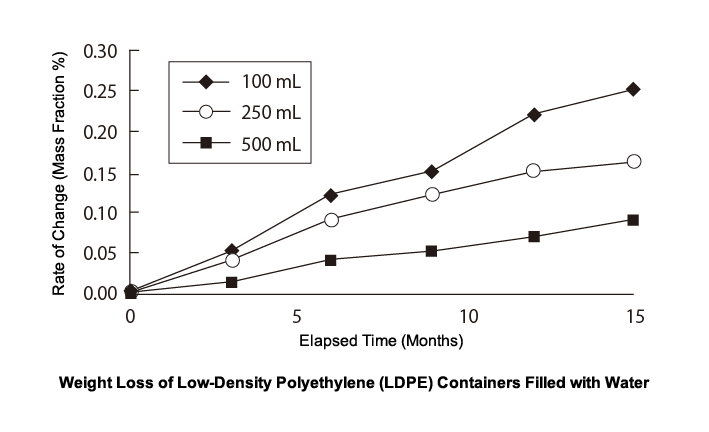
7) Transferring reagents to another container is generally not recommended. Reagents are quality-guaranteed along with their original containers, and transferring them can change their condition. The permeability of the container to water vapor and other substances can particularly become an issue. Generally, evaporation loss occurs primarily around the cap and not through the container walls. It is also affected by the contact area between the gas phase and the solution. For standard solutions, changes tend to increase when only a small amount remains; if the remaining amount is between 5 mm and 1 cm from the bottom, it is desirable to discard it rather than using it to the end.
8) When diluting standard solutions, controlling the liquid temperature is important. When strict quality control is required, dilution is often performed at 20°C. In such cases, if using glass volumetric glassware, it is necessary to calibrate it in accordance with JIS K 0050 (General Rules for Chemical Analysis Procedures).
9) For light-sensitive reagents, measures such as using amber glass containers are essential.
-
When using reagents, it is important to be aware of the precautions in advance.
1) It is important to strictly follow the precautions displayed on the label. Reagents classified as hazardous, poisonous, or deleterious substances must be handled in compliance with relevant laws and regulations, even in small quantities. When harmful gases are generated, local exhaust ventilation must be used. If substances are highly corrosive, the use of protective gloves is essential. Furthermore, flammable reagents such as organic solvents must never be handled near open flames or heat sources.
2) Preventing reagents from deteriorating during use is also critical. Depending on the properties of the reagent, measures such as avoiding direct sunlight or handling them within a cleanroom or dry room are necessary.
3) For liquid reagents, confirmation before use is important. In summer, droplets may adhere to the mouth or neck of the bottle; this is a result of condensation from volatilized vapor, which can change the concentration of a standard solution. In such cases, gently swirl the reagent bottle to ensure uniformity before opening the cap. Conversely, vigorous shaking should be avoided, as it can cause issues such as increased internal pressure in volatile reagents or easier absorption of carbon dioxide in alkaline reagents.
4) Precautions when opening reagent caps are also vital. In cases where gas is generated inside the bottle and it is pressurized, such as with ammonia water, the contents may spray out. For such reagents, it is best to slowly loosen the cap to reduce internal pressure before opening, or to cover the cap with a laboratory wiper towel and open it while wearing protective gloves.
5) When taking reagents out of a bottle, it is desirable to remove the required amount quickly and recap immediately to avoid accelerating deterioration. For liquids, it is also important not to let the liquid adhere to the threads of the cap. If liquid adheres to the threads, such as with aqueous salt solutions, crystals may precipitate there, which can lead to leaks or the ingress of carbon dioxide into the bottle. Furthermore, in the case of solvents, the resin of the cap may dissolve, potentially causing the cap to become stuck.
6) Reagents should be used up as soon as possible and should not be stored for long periods. This is especially true for those prone to rapid deterioration. Since changes often accelerate after opening, it is also important to record and manage the date of opening.
7) Transferring reagents to another container is generally not recommended. Reagents are quality-guaranteed along with their original containers, and transferring them can change their condition. The permeability of the container to water vapor and other substances can particularly become an issue. Generally, evaporation loss occurs primarily around the cap and not through the container walls. It is also affected by the contact area between the gas phase and the solution. For standard solutions, changes tend to increase when only a small amount remains; if the remaining amount is between 5 mm and 1 cm from the bottom, it is desirable to discard it rather than using it to the end.
8) When diluting standard solutions, controlling the liquid temperature is important. When strict quality control is required, dilution is often performed at 20°C. In such cases, if using glass volumetric glassware, it is necessary to calibrate it in accordance with JIS K 0050 (General Rules for Chemical Analysis Procedures).
9) For light-sensitive reagents, measures such as using amber glass containers are essential.
-
Disposal of Reagents and Test Solutions
- When disposing of unused reagents and test solutions, it is necessary to thoroughly read the Safety Data Sheet (SDS) and process them correctly, as they may be subject to legal regulations. Furthermore, if the amount for a single disposal is small and is stored until it reaches a certain volume before requesting a disposal contractor to process it, it must be managed with consideration for legal regulations and safety.