

Production Methods
"The variety of reagents required for testing, research, and physical property measurements far exceeds that of chemicals used in standard industrial processes. Even for the same substance, different quality levels are required depending on the intended application. Individual reagent suppliers handle tens of thousands of different items, and the total number of products across various grades and specifications reaches hundreds of thousands. Furthermore, because reagents are used in relatively small quantities for research purposes, production units (lots) are significantly smaller than those of industrial chemicals. Handling volumes range from several thousand kilograms per lot at the high end to as little as a few milligrams at the low end, with some items manufactured only once every few years. To accommodate this high-mix, low-volume production, reagent manufacturing typically employs small-scale batch processes rather than the continuous production lines seen in industrial chemistry.
Additionally, due to the sheer variety of products, it is practically impossible—with very few exceptions—to have dedicated production facilities for each item. Therefore, it is common practice to produce a wide range of reagents using shared multipurpose facilities."
Quality of Reagents
Reagents are managed with high-quality standards tailored to their intended use. A key characteristic of reagent quality is not only high purity but also the suppression of specific impurities that could adversely affect their application. Furthermore, great importance is placed on both homogeneity within a single lot and consistency between different lots.
Unlike industrial chemicals produced through continuous mass production, reagents manufactured via small-batch processes present challenges in adjusting manufacturing conditions. Therefore, rigorous process control is implemented at every stage—from raw material management (ensuring the uniformity of raw and auxiliary materials) to charging, reaction, crystallization, distillation, purification, and packaging.
In reagent manufacturing, general industrial chemicals are often purchased and used as raw materials for synthesis or purification. However, if an industrial chemical already possesses sufficiently high quality, it may be commercialized as a reagent without further processing, provided it passes stringent quality tests for that purpose.
Labeling of Reagents
Reagent labels display essential information, including the product name and lot number. For reagents susceptible to degradation over time, the date of manufacture (or its abbreviation), information on stabilizers, storage conditions, and safety information are also provided.
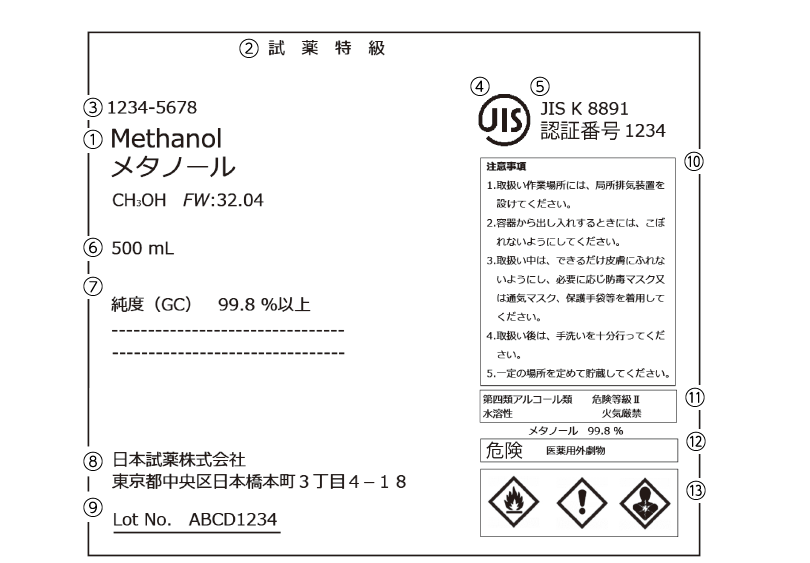
Example of Reagent Labeling
① Product Name ② Grade ③ Catalog Number ④ JIS Mark ⑤ JIS Standard Number ⑥ Net Content ⑦ Specifications ⑧ Manufacturer Name and Address ⑨ Lot Number ⑩ Precautions for Hazardous Substances under the Industrial Safety and Health Act ⑪ Hazardous Materials Labeling under the Fire Service Act ⑫ Labeling for Poisonous and Deleterious Substances Control Act ⑬ GHS Pictograms
Reagent Containers
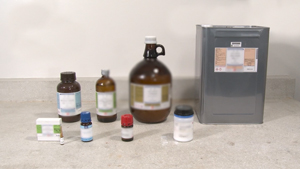
Reagents are most commonly packaged in units of 500 g (or 500 mL) or 25 g (or 25 mL). Other available sizes include 100 mg, 1 g, 50 g, 100 g, 15 kg, 25 kg, 1 L, 3 L, and 18 L. These small packaging units are a key characteristic of reagents, and both packaging and containers are carefully designed to prevent any change in quality. Containers are typically made of glass, synthetic resins (such as polyethylene or polypropylene), or metal, selected appropriately based on the properties of the reagent. To prevent the entry of foreign matter or moisture and to avoid loss, efflorescence, deliquescence, or evaporation of the contents, highly airtight containers are frequently used. In cases where it is particularly necessary to prevent volatilization or the ingress of gases, hermetically sealed containers such as ampoules are employed. Furthermore, when protection from light is required, light-shielding containers such as amber glass bottles are used.